

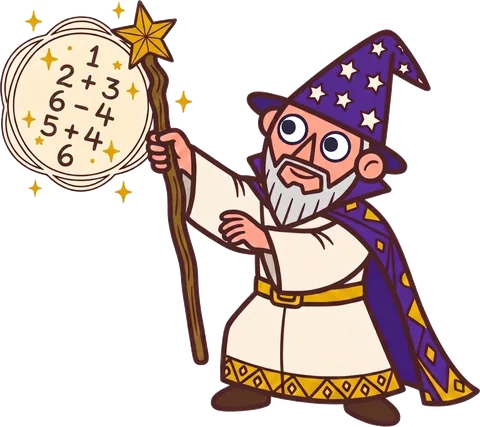
You always hold two fate numbers from 1 to 7. You may only take a card if its rule holds for both numbers together.
Go through the cards one at a time and check each one: work out the sum, or look at the difference.
In some tasks one of your numbers is hidden. Then try the numbers 1 to 7 - only one fits the rule.
Example
For parents
What does this exercise practice?
Oracle cards practice checking a condition - sum, difference, odd or even - and then working backwards when a number is missing.
Common pitfalls
A common mistake is stopping at the first card that looks about right. Only the card whose rule really holds for both numbers counts.
How to practice at home
Lay out a pair with two playing cards or dice and take turns inventing rules that hold for it ("the sum is even", "the difference is 2").