

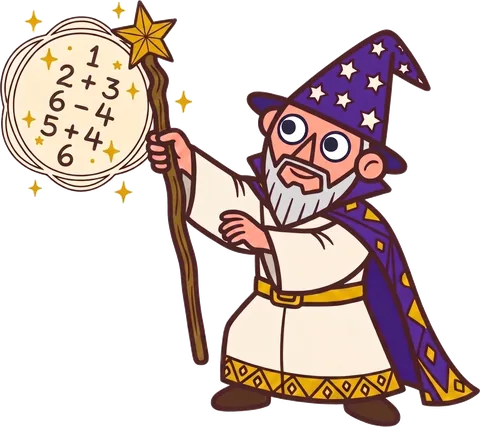
What is happening here?
Grade 3 brings the written method: numbers are written one under the other by place value and added from right to left, ones, tens, hundreds. When a column goes past 9, 10 ones move on as one ten into the next column. That is nothing other than the bundling from the number range up to 1000.
That is why the book first has calculating in steps, then the method. A child who has understood 10 ones = 1 ten calculates the columns with meaning, not by recipe.
What helps at home
Squared paper helps: one digit per square, and the places line up by themselves. Most mistakes are mistakes of order, not of calculation.
Have your child estimate before calculating: 478 + 233 is about 500 + 200. If 611 comes out, something is off. Estimating is the best self-check, and it takes ten seconds. For subtraction, check by adding back: the result plus the number taken away must give the starting number.
What can go wrong
The classic is subtraction with borrowing: a child works "bigger minus smaller" in every column, which turns 4 − 7 into 7 − 4. Then ask "Can I take 7 away from 4?" and unbundle: one ten becomes 10 ones, and 4 becomes 14.
Forgotten carries are the second classic. The little carry mark under the line is no decoration, it is the memo note. If it does not help, go back to calculating in steps: writing the steps down forgets nothing.